YOU ARE ACCESSING THE LCARS COMMAND INTERFACE - TECHNICAL DATABANK
Cloaking Device
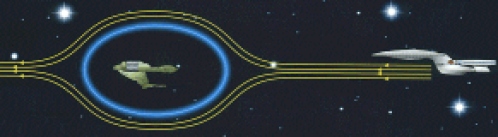
A cloaking device is an energy screen generator used to render an object (typically, a space vehicle) invisible to the eye and to most sensor systems. This is accomplished by gravitational lensing, the creation of a distorted image of an object when it's light is focused by gravity. In the case of a cloaking device, the light is focused so that the object's index of refraction (the phase velocity of radiation in free space divided by the phase velocity of the same radiation in a specified medium) matches its surroundings, making the object transparent. Cloaking a ship requires precisely balancing the radiative emissions from the warp drive nacelles, dissipating all electromagnetic radiation, gravitational fields and other energy emissions emanating from the ship, and distorting space in such a way that electromagnetic radiation and energy emissions are directed around the ship through subspace at velocities faster than light.
Episode: TNG 101 - Encounter at Farpoint, Part I On Stardate 1709.1 the Bonhomme Ri Romulan Space.
Then suddenly, it vanished from the sensors, reappeared directly in front of the outpost and fired what later came to be called a "plasma torpedo". The torpedo obliterated the outpost's deflector screens, nearly destroying it. A second shot finished the intruder's job. Then the ship simply disappeared from view. That was the first encounter with the Romulans after almost a century since the battle of Cheron. The vessel that destroyed S-4023 (and also S-4024 and S-4025) was a Romulan P-1A Bird of Prey with a first generation cloaking device. Later, a third generation cloaking device has been obtained by the U.S.S. Enterprise in an espionage mission.

The Klingons Empire gained the technology from their alliance with the Romulans in exchange for their D-6 Raxor and D-7 Klolode battle cruisers. Thus the three major powers in this part of the galaxy came to posses what proved to be one of the most formidable weapons ever.

The Klingon Empire has used the cloaking technology ever since their technology exchange with the Romulans in 2263, and continues to do so. Nearly all of its Bird of Prey type ships are equipped with it as are the D- 6, D-7, D-8 (K'T'Inga), and the new K'Vort class battle cruisers.
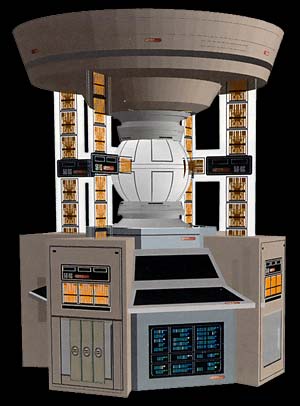
The Klingon Empire naturally still uses the cloaking device. Although much about them is now unknown due to the fifty-year contact breach after the Tomad incident, it is certain that their newest vessels, the D'Deridex class warbirds, are equipped with a new generation of cloaking devices which have so far defied all Federation attempts at detection without the use of tachyons.
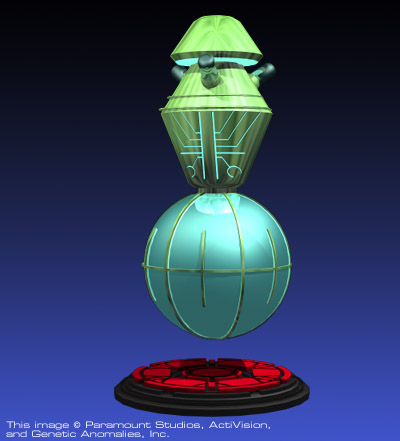
In 2358, the Starship Pegasus was commanded by Captain Erik Pressman. The crew compliment included Lieutenant Boylen and Ensign William Riker, on his first assignment out of the Academy. At the time, the Pegasus was conducting a secret test of a Federation interphase cloaking device, in violation of the Treaty of Algeron.
Several members of the crew, including the first officer and chief engineer, objected to the illegal test, and mutinied in an attempt to shut down the cloaking device.
These events surrounding the U.S.S. Pegasus that used in this controversial cloaking device experiments several years ago, is still considered a classified matter by Starfleet Command. However, as speculation, it is indeed possible that the initial experiments may have continued behind the scenes, for what remained of the vessel and mission data being at some time recovered (I would have thought that Starfleet would not leave it marooned in that asteroid for the Romulans to get hold of). But the exact whereabouts and status of the vessel, and under whose authority the matter lies, is still unknown.
The Interphase Cloak
This is a cloaking device that manipulates the molecular structure of matter in a way that it is transferred to a parallel space. Matter cloaked with an interphase generator is not only invisible to conventional natural and artificial sensors, it is also able to penetrate normal matter. An interphase generator was installed in the U.S.S. Pegasus in 2358, although cloaking devices are prohibited in the Federation according to the Algeron Treaty (TNG: "The Pegasus"). The Romulans tested such a cloaking device in 2368. When the experiment failed and the Enterprise arrived to assist the Romulan ship, Geordi and Laren were affected by this device and disappeared. However, while being in phase, they were still able to stand on the floor and breathe normal air (TNG: "The Next Phase"). The shown effects are much too inconsistent to determine whether the cloaked object disappears to a parallel dimension or to subspace or anywhere else.
The Treaty of Algeron (between the United Federation of Planets and the Romulan Star Empire) did not stop Starfleet Intelligence from secretly and illegally developing the Interphase Cloaking Device, a device which not only rendered a starship invisible, but also allowed it to pass through solid matter unimpeded. The device was lost in 2358 when the test-bed vessel, the U.S.S. Pegasus as mentioned above, was destroyed in a mutiny by members of the crew concerned about the legality of the test.

In 2370, the existence of the illegal device was made public to the Romulans. (TNG: "The Pegasus") In 2368 the Romulans also unsuccessfully experimented with phased cloaking technology. The USS Enterprise-D had received a distress signal from the test-bed vessel, and Captain Jean-Luc Picard ordered an away team sent over to assist. During the mission, due to a malfunction in the device, Ensign Ro Laren and Lieutenant Commander Geordi La Forge were phase-cloaked during beam-out, and rematerialized on different parts of the Enterprise. After several attempts to bring them back, the crew gave up, believing them dead. Soon, Ro and La Forge encountered a similarly phase-cloaked Romulan officer that had followed them to the Enterprise in an attempt to keep the new cloaking device a secret. They fought off the Romulan, who was trying to kill them, and threw him through a bulkhead and out of the Enterprise completely. Eventually, Ro and La Forge succeeded in revealing what had happened to them to the crew, and Lieutenant Commander Data managed to reverse the effects of the cloak, bringing them back into phase. (TNG: "The Next Phase")
Cloaking devices have been classified into the following categories according to their overall effectiveness:
Mk 1 Cloak: Original usage, early Warbirds only. Used electromagnetic radiation shielding quite effectively to cloak only visible and near-visible radiation. Can instantaneously cloak and decloak, but required large amounts of power.
Mk 2 Cloak: A major improvement on the Mk 1, this device cloaked all electromagnetic radiation, except high energy Gamma rays. Can instantaneously cloak and decloak, but was remarkably inefficient. Craft: Romulan Scouts and Warbirds, also Klingon D-7 Cruisers, and later the joint Romulan/Klingon scout and Bird Of Prey.
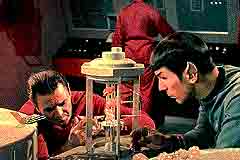
Scotty and Spock examine an early type Cloaking Device
Mk 3.0 Cloak: The first gravity distorting cloak. The early prototype craft had problems with energetic effects occurring inside the cloak as a result of trapped spurious thermal emissions within the cloaking field. This was overcome by giving the craft a green coloration. This tuned the thermal energy to a frequency where it could leak very slowly through the cloak without revealing the ships presence, still common practice on most cloaked vessels. This early Mk 3 had only the spherical field setting and could not be effectively wave-mapped. It could not instantly cloak and decloak, but saw much use on most Romulan craft and the Bird Of Prey.
Mk 3.1 Cloak: This improved device featured instantaneous propagation of the spherical cloak, and first saw use of the wave-mapped cloak. It is reported to have been used as above and as an upgraded cloak for D-7 Cruisers. A green coloration was still necessary.
Mk 3.2 Cloak: This version saw the creation of the fine tuned cloak, using the special dedicated computers. This device was perhaps first created by the Klingons, but required large power reserves. The Romulans later reworked the idea into a more efficient form (officially designated the Mark 3.2a). The old cloak is still in active service on older Klingon craft.
Mk 3.2a Cloak: Romulan reworking of the 3.2. No special coloration of the craft is necessary, although the nullifier cores require less energy when the ship has a green colour. The cloak is still extensively used by Romulans and Klingons alike.
Mk 3.3 Cloak: This latest version allowed powering down of all non-finely tuned cloaks instantly. It is only fitted, as far as is known, to Romulan Warbirds. Klingons claim to still use the 3.2a.
Experimental Mk 4 Cloak: There is an experimental cloaking device which utilizes a highly-wave-mapped, adaptive, asymmetrical dispersion pattern. This cloaking device's cloaking generator coils are equipped with field actuators that change the dispersion pattern, to be most efficient in any interstellar condition, considering many variables, such as gas density, electric and magnetic fields, and fluctuations in the subspace domain. These field actuators compensate for any of these variables or active scans if the vicinity of the cloaked ship is being probed. There is no danger of a spatial ripple occurring. This would render a ship undetectable, except with a tachyon heterodyne detection grids, which, if powerful enough, could detect a ship that was cloaked in this manner.
Star Fleet, which used the cloaking device on its vessels in the late 2200's and early 2300's, has decided that the peaceful (mostly) mission definition of the Explorer type of starships precludes its use. Further- more, the overall shape and hull materials used in the Galaxy, Ambassador, and Oberth Class starships would interfere with the cloaking device. Although it is still possible to cloak them, the energy necessary increases beyond reasonable limit. Today, only specialized scouting, stealth, and battle ships use cloaking devices.



Last edited by Adge - December 2004

A cloaking device is an energy screen generator used to render an object (typically, a space vehicle) invisible to the eye and to most sensor systems. This is accomplished by gravitational lensing, the creation of a distorted image of an object when it's light is focused by gravity. In the case of a cloaking device, the light is focused so that the object's index of refraction (the phase velocity of radiation in free space divided by the phase velocity of the same radiation in a specified medium) matches its surroundings, making the object transparent. Cloaking a ship requires precisely balancing the radiative emissions from the warp drive nacelles, dissipating all electromagnetic radiation, gravitational fields and other energy emissions emanating from the ship, and distorting space in such a way that electromagnetic radiation and energy emissions are directed around the ship through subspace at velocities faster than light.
Episode: TNG 101 - Encounter at Farpoint, Part I On Stardate 1709.1 the Bonhomme Ri Romulan Space.
Then suddenly, it vanished from the sensors, reappeared directly in front of the outpost and fired what later came to be called a "plasma torpedo". The torpedo obliterated the outpost's deflector screens, nearly destroying it. A second shot finished the intruder's job. Then the ship simply disappeared from view. That was the first encounter with the Romulans after almost a century since the battle of Cheron. The vessel that destroyed S-4023 (and also S-4024 and S-4025) was a Romulan P-1A Bird of Prey with a first generation cloaking device. Later, a third generation cloaking device has been obtained by the U.S.S. Enterprise in an espionage mission.
The Klingons Empire gained the technology from their alliance with the Romulans in exchange for their D-6 Raxor and D-7 Klolode battle cruisers. Thus the three major powers in this part of the galaxy came to posses what proved to be one of the most formidable weapons ever.
The Klingon Empire has used the cloaking technology ever since their technology exchange with the Romulans in 2263, and continues to do so. Nearly all of its Bird of Prey type ships are equipped with it as are the D- 6, D-7, D-8 (K'T'Inga), and the new K'Vort class battle cruisers.
The Klingon Empire naturally still uses the cloaking device. Although much about them is now unknown due to the fifty-year contact breach after the Tomad incident, it is certain that their newest vessels, the D'Deridex class warbirds, are equipped with a new generation of cloaking devices which have so far defied all Federation attempts at detection without the use of tachyons.
In 2358, the Starship Pegasus was commanded by Captain Erik Pressman. The crew compliment included Lieutenant Boylen and Ensign William Riker, on his first assignment out of the Academy. At the time, the Pegasus was conducting a secret test of a Federation interphase cloaking device, in violation of the Treaty of Algeron.
Several members of the crew, including the first officer and chief engineer, objected to the illegal test, and mutinied in an attempt to shut down the cloaking device.
These events surrounding the U.S.S. Pegasus that used in this controversial cloaking device experiments several years ago, is still considered a classified matter by Starfleet Command. However, as speculation, it is indeed possible that the initial experiments may have continued behind the scenes, for what remained of the vessel and mission data being at some time recovered (I would have thought that Starfleet would not leave it marooned in that asteroid for the Romulans to get hold of). But the exact whereabouts and status of the vessel, and under whose authority the matter lies, is still unknown.
The Interphase Cloak
This is a cloaking device that manipulates the molecular structure of matter in a way that it is transferred to a parallel space. Matter cloaked with an interphase generator is not only invisible to conventional natural and artificial sensors, it is also able to penetrate normal matter. An interphase generator was installed in the U.S.S. Pegasus in 2358, although cloaking devices are prohibited in the Federation according to the Algeron Treaty (TNG: "The Pegasus"). The Romulans tested such a cloaking device in 2368. When the experiment failed and the Enterprise arrived to assist the Romulan ship, Geordi and Laren were affected by this device and disappeared. However, while being in phase, they were still able to stand on the floor and breathe normal air (TNG: "The Next Phase"). The shown effects are much too inconsistent to determine whether the cloaked object disappears to a parallel dimension or to subspace or anywhere else.
The Treaty of Algeron (between the United Federation of Planets and the Romulan Star Empire) did not stop Starfleet Intelligence from secretly and illegally developing the Interphase Cloaking Device, a device which not only rendered a starship invisible, but also allowed it to pass through solid matter unimpeded. The device was lost in 2358 when the test-bed vessel, the U.S.S. Pegasus as mentioned above, was destroyed in a mutiny by members of the crew concerned about the legality of the test.
In 2370, the existence of the illegal device was made public to the Romulans. (TNG: "The Pegasus") In 2368 the Romulans also unsuccessfully experimented with phased cloaking technology. The USS Enterprise-D had received a distress signal from the test-bed vessel, and Captain Jean-Luc Picard ordered an away team sent over to assist. During the mission, due to a malfunction in the device, Ensign Ro Laren and Lieutenant Commander Geordi La Forge were phase-cloaked during beam-out, and rematerialized on different parts of the Enterprise. After several attempts to bring them back, the crew gave up, believing them dead. Soon, Ro and La Forge encountered a similarly phase-cloaked Romulan officer that had followed them to the Enterprise in an attempt to keep the new cloaking device a secret. They fought off the Romulan, who was trying to kill them, and threw him through a bulkhead and out of the Enterprise completely. Eventually, Ro and La Forge succeeded in revealing what had happened to them to the crew, and Lieutenant Commander Data managed to reverse the effects of the cloak, bringing them back into phase. (TNG: "The Next Phase")
Cloaking devices have been classified into the following categories according to their overall effectiveness:
Mk 1 Cloak: Original usage, early Warbirds only. Used electromagnetic radiation shielding quite effectively to cloak only visible and near-visible radiation. Can instantaneously cloak and decloak, but required large amounts of power.
Mk 2 Cloak: A major improvement on the Mk 1, this device cloaked all electromagnetic radiation, except high energy Gamma rays. Can instantaneously cloak and decloak, but was remarkably inefficient. Craft: Romulan Scouts and Warbirds, also Klingon D-7 Cruisers, and later the joint Romulan/Klingon scout and Bird Of Prey.
Scotty and Spock examine an early type Cloaking Device
Mk 3.0 Cloak: The first gravity distorting cloak. The early prototype craft had problems with energetic effects occurring inside the cloak as a result of trapped spurious thermal emissions within the cloaking field. This was overcome by giving the craft a green coloration. This tuned the thermal energy to a frequency where it could leak very slowly through the cloak without revealing the ships presence, still common practice on most cloaked vessels. This early Mk 3 had only the spherical field setting and could not be effectively wave-mapped. It could not instantly cloak and decloak, but saw much use on most Romulan craft and the Bird Of Prey.
Mk 3.1 Cloak: This improved device featured instantaneous propagation of the spherical cloak, and first saw use of the wave-mapped cloak. It is reported to have been used as above and as an upgraded cloak for D-7 Cruisers. A green coloration was still necessary.
Mk 3.2 Cloak: This version saw the creation of the fine tuned cloak, using the special dedicated computers. This device was perhaps first created by the Klingons, but required large power reserves. The Romulans later reworked the idea into a more efficient form (officially designated the Mark 3.2a). The old cloak is still in active service on older Klingon craft.
Mk 3.2a Cloak: Romulan reworking of the 3.2. No special coloration of the craft is necessary, although the nullifier cores require less energy when the ship has a green colour. The cloak is still extensively used by Romulans and Klingons alike.
Mk 3.3 Cloak: This latest version allowed powering down of all non-finely tuned cloaks instantly. It is only fitted, as far as is known, to Romulan Warbirds. Klingons claim to still use the 3.2a.
Experimental Mk 4 Cloak: There is an experimental cloaking device which utilizes a highly-wave-mapped, adaptive, asymmetrical dispersion pattern. This cloaking device's cloaking generator coils are equipped with field actuators that change the dispersion pattern, to be most efficient in any interstellar condition, considering many variables, such as gas density, electric and magnetic fields, and fluctuations in the subspace domain. These field actuators compensate for any of these variables or active scans if the vicinity of the cloaked ship is being probed. There is no danger of a spatial ripple occurring. This would render a ship undetectable, except with a tachyon heterodyne detection grids, which, if powerful enough, could detect a ship that was cloaked in this manner.
Star Fleet, which used the cloaking device on its vessels in the late 2200's and early 2300's, has decided that the peaceful (mostly) mission definition of the Explorer type of starships precludes its use. Further- more, the overall shape and hull materials used in the Galaxy, Ambassador, and Oberth Class starships would interfere with the cloaking device. Although it is still possible to cloak them, the energy necessary increases beyond reasonable limit. Today, only specialized scouting, stealth, and battle ships use cloaking devices.
Last edited by Adge - December 2004