YOU ARE ACCESSING THE LCARS COMMAND INTERFACE - TECHNICAL DATABANK
Antimatter
Since its confirmed existence in the 1930s, the concept of a form of matter with the same mass but reversed charge and spin has intrigued scientists and engineers as a means to produce unprecedented amounts of energy, and to apply that energy to drive large space vehicles.

Cosmological theory maintains that all constituent parts of the universe were created in pairs; that is, one particle of matter and one particle of antimatter. Why there seems to be a propensity toward matter in our galactic neighbourhood is, to this day, a topic of lively discussion. All of the basic antiparticle have been synthesized, however, and are available for continued experimental and operational use
When, for example, an electron and an anti-electron (or positron) are in close proximity, they mutually annihilate, producing energetic gamma rays. Other particle-antiparticle pairs annihilate into different combinations of subatomic particles and energy. Of particular interest to spacecraft engineers were the theoretical results presented by deuterium, and isotope of hydrogen, and its antimatter equivalent. The problems encountered along the way to achieving a working M/A engine, however, were as daunting as the possible rewards were glorious. Antimatter, from the time of its creation, could neither be contained by nor touch any matter. Numerous schemes were proposed to contain antihydrogen by magnetic fields. This continues to be the accepted method. Appreciable amounts of antihydrogen, in the form of liquid or, better yet, slush, posed significant risks should any portion of the magnetic containment fail. Within the last fifty years, reliable superconducting field sustainers and other measures have afforded a greater degree of safety aboard operational Starfleet vessels.
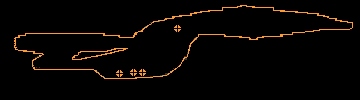
As use aboard the USS Enterprise, antimatter is first generated at major Starfleet fueling facilities by combined solar-fusion charge reversal devices, which process proton and neutron beams into antideuterons, and are joined by a positron beam accelerator to produce antihydrogen (specifically antideuterium). Even with the added solar dynamo input, there is a net energy loss of 24% using this process, but this loss is deemed acceptable by Starfleet to conduct distant interstellar operations.
The antimatter is kept contained by magnetic conduits and compartmentalized tankage while aboard the fueling facility. Early starships were also constructed with compartmentalized tankage in place, though this method proved less desirable from a safety standpoint in a ship subjected to high stresses. During normal refuelling, antimatter is passed through the loading port, a 1.75 meter-wide circular probe-and-drogue device equipped with twelve physical hard-dock latches and magnetic irises. Surrounding the antimatter loading port on Deck 42 are thirty storage pods, each measuring 4x8 meters and constructed of polyduranium, with an inner magnetic field layer of ferric quonium. Each pod contains a maximum volume of 100 mE3 of antimatter, giving a 30-pod total starship supply of 3000 mE3, enough for a normal mission period of three years. Each is connected by shielded conduits to a series of distribution manifolds, flow controllers, and electro plasma system (EPS) power feed inputs. In rapid refuelling conditions, reserved for emergency situations, the entire antimatter storage pod assembly (ASPA) can be drawn down on jackscrews and replaced in less than one hour.
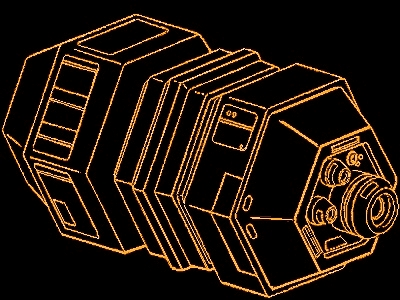
In the event of loss of magnetic containment, this very same assembly can be ejected by microfusion initiators at a velocity of 40 m/sec, pushing it clear of the ship before the field decy and the antimatter has a chance to react with the pod walls (see also: Emergency Shutdown Procedures. While small groups of pods can be replaced under normal conditions, the magnetic pump transfer method is preferred.
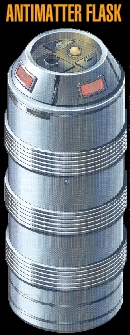
Antimatter, even contained within storage pods, cannot be moved by transporter without extensive modifications to the pattern buffer, transfer conduits, and transporter emitters for safety reasons due to the highly volatile nature of antimatter. (Specific exceptions apply for small quantities of antimatter stored in approved magnetic containment devices, normally used for specialized engineering and scientific applications).
Refueling while in interstellar space is possible through the use of Starfleet tanker craft. Tanker transfers run considerable risks, not so much for hardware problems but because refine antimatter is a valuable commodity, and vulnerable to Threat force capture or destruction while in transit. Starfleet cruiser escorts are standard procedure for all tanker movements.



Last edited by Adge - September 2004
Since its confirmed existence in the 1930s, the concept of a form of matter with the same mass but reversed charge and spin has intrigued scientists and engineers as a means to produce unprecedented amounts of energy, and to apply that energy to drive large space vehicles.
Cosmological theory maintains that all constituent parts of the universe were created in pairs; that is, one particle of matter and one particle of antimatter. Why there seems to be a propensity toward matter in our galactic neighbourhood is, to this day, a topic of lively discussion. All of the basic antiparticle have been synthesized, however, and are available for continued experimental and operational use
When, for example, an electron and an anti-electron (or positron) are in close proximity, they mutually annihilate, producing energetic gamma rays. Other particle-antiparticle pairs annihilate into different combinations of subatomic particles and energy. Of particular interest to spacecraft engineers were the theoretical results presented by deuterium, and isotope of hydrogen, and its antimatter equivalent. The problems encountered along the way to achieving a working M/A engine, however, were as daunting as the possible rewards were glorious. Antimatter, from the time of its creation, could neither be contained by nor touch any matter. Numerous schemes were proposed to contain antihydrogen by magnetic fields. This continues to be the accepted method. Appreciable amounts of antihydrogen, in the form of liquid or, better yet, slush, posed significant risks should any portion of the magnetic containment fail. Within the last fifty years, reliable superconducting field sustainers and other measures have afforded a greater degree of safety aboard operational Starfleet vessels.
As use aboard the USS Enterprise, antimatter is first generated at major Starfleet fueling facilities by combined solar-fusion charge reversal devices, which process proton and neutron beams into antideuterons, and are joined by a positron beam accelerator to produce antihydrogen (specifically antideuterium). Even with the added solar dynamo input, there is a net energy loss of 24% using this process, but this loss is deemed acceptable by Starfleet to conduct distant interstellar operations.
The antimatter is kept contained by magnetic conduits and compartmentalized tankage while aboard the fueling facility. Early starships were also constructed with compartmentalized tankage in place, though this method proved less desirable from a safety standpoint in a ship subjected to high stresses. During normal refuelling, antimatter is passed through the loading port, a 1.75 meter-wide circular probe-and-drogue device equipped with twelve physical hard-dock latches and magnetic irises. Surrounding the antimatter loading port on Deck 42 are thirty storage pods, each measuring 4x8 meters and constructed of polyduranium, with an inner magnetic field layer of ferric quonium. Each pod contains a maximum volume of 100 mE3 of antimatter, giving a 30-pod total starship supply of 3000 mE3, enough for a normal mission period of three years. Each is connected by shielded conduits to a series of distribution manifolds, flow controllers, and electro plasma system (EPS) power feed inputs. In rapid refuelling conditions, reserved for emergency situations, the entire antimatter storage pod assembly (ASPA) can be drawn down on jackscrews and replaced in less than one hour.
In the event of loss of magnetic containment, this very same assembly can be ejected by microfusion initiators at a velocity of 40 m/sec, pushing it clear of the ship before the field decy and the antimatter has a chance to react with the pod walls (see also: Emergency Shutdown Procedures. While small groups of pods can be replaced under normal conditions, the magnetic pump transfer method is preferred.
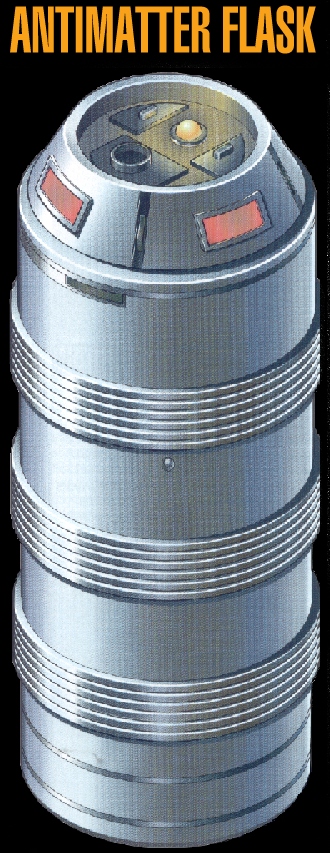
Antimatter, even contained within storage pods, cannot be moved by transporter without extensive modifications to the pattern buffer, transfer conduits, and transporter emitters for safety reasons due to the highly volatile nature of antimatter. (Specific exceptions apply for small quantities of antimatter stored in approved magnetic containment devices, normally used for specialized engineering and scientific applications).
Refueling while in interstellar space is possible through the use of Starfleet tanker craft. Tanker transfers run considerable risks, not so much for hardware problems but because refine antimatter is a valuable commodity, and vulnerable to Threat force capture or destruction while in transit. Starfleet cruiser escorts are standard procedure for all tanker movements.
Last edited by Adge - September 2004