YOU ARE ACCESSING THE LCARS COMMAND INTERFACE - TECHNICAL DATABANK
PADD

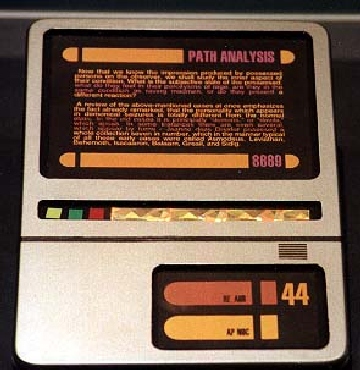
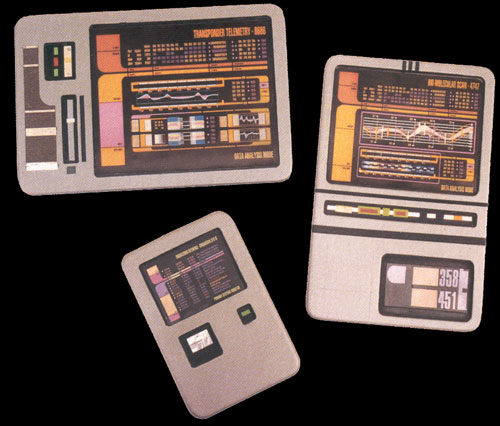
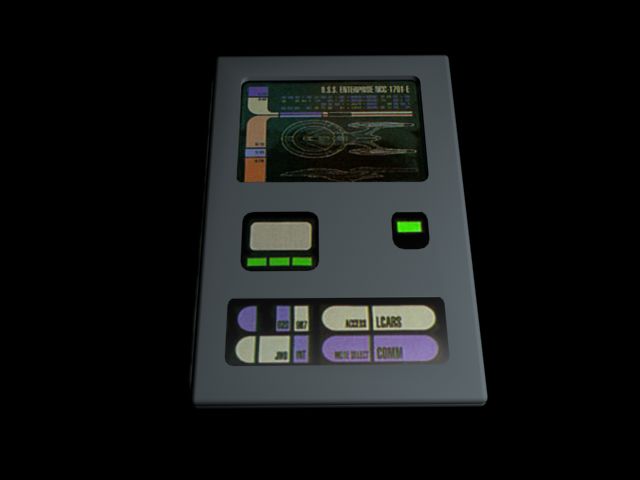
The Personal Access Display Device has been, and still is, the best method of transferring and executing data between various personnel. It is a small handheld control and display terminal, typically not much larger than a human hand, though larger ones have been used, and is linked directly to the vessel's main computer. The device is sufficiently isolated from the ship's computer though, so that high level computer systems can not be accessed from the PADD. Virtually all known space faring races have some form of PADD, each with their own distinctive design attributed to that particular culture.
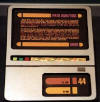
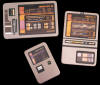
It has been theorised, though never attempted, that a properly configured PADD could allow the user to fly a Starship from anywhere on board the ship. Though this is obviously impractical, it demonstrates the versatility of the PADDs.
In its primary role aboard a Starship, the personal access display device (padd) is a handheld control and display terminal. Small, easily managed terminals and computers are in daily use throughout Starfleet, as a natural response to crew members' needs to (1) execute hardware functions in a variety of locations, and (2) manipulate visual information and communicate that information to others aboard ship. Access to Starfleet computers and other pieces of equipment can be accomplished through the usual control displays and larger terminal screens, of course, but the PADD has become a convenient adjunct to those panels

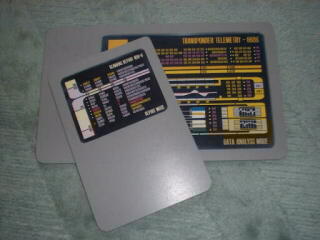
The standard small padd is 10 x 15 x 1 cm and is constructed from three basic layers of imbedded circuit-composite material. All primary electronics, including multi-layer display screen, are bonded to the casing. If dropped accidentally, even from a height of 35 m, a padd will remain undamaged. Replaceable components are limited to three, the sarium power loop, isolinear memory chip, and subspace transceiver assembly (STA) .
In normal daily use, the power supply remains installed and is induction recharged. A full charge will last sixteen hours; if a padd is about to exhaust its battery, it can set a memory flag in the main computer to transfer tasks to a working unit, or suspend them until a later time. The total memory capacity of the isolinear chips is 4.3 kiloquads. Like the tricorder, the padd can transfer its total memory to the main computers in less than one second if the need arises. The STA is used to maintain data channels between the padd and the Starships computer. If taken on an away mission, the padd can also perform uplink / downlink operations and function as a transporter lock-on node. Data transmissions and computing functions can be shared with any other Starfleet device supporting the STA com protocols. As with the personal communicator, transmissions are encrypted for security purposes.
The display screen, 4.25 times larger than that of a tricorder, allows for the manipulation of control graphics, numerical data, and images by touch. Electro-sensitive areas of the casing (coloured brown on the standard engineering padd) are designed for specific data movement and storage functions. They can also be used to personalize the default setup and single-crew member security restriction. An audio pickup sensor permits voice input.

The padd's control functions mimic those of any multi-layer panel, insofar as the security restrictions for individual crew members are concerned. Properly configured with the Conn position bridge controls, a crew member can theoretically fly a starship from a padd while walking down a corridor.
Custom padd configurations can be fabricated in any starship hardware replication facility equipped with custom isolinear circuit programming capabilities.



Last edited by Adge - August 2004

The Personal Access Display Device has been, and still is, the best method of transferring and executing data between various personnel. It is a small handheld control and display terminal, typically not much larger than a human hand, though larger ones have been used, and is linked directly to the vessel's main computer. The device is sufficiently isolated from the ship's computer though, so that high level computer systems can not be accessed from the PADD. Virtually all known space faring races have some form of PADD, each with their own distinctive design attributed to that particular culture.
It has been theorised, though never attempted, that a properly configured PADD could allow the user to fly a Starship from anywhere on board the ship. Though this is obviously impractical, it demonstrates the versatility of the PADDs.
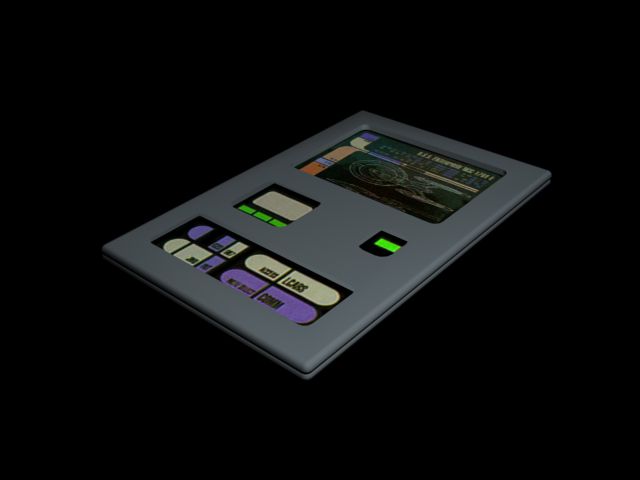
In its primary role aboard a Starship, the personal access display device (padd) is a handheld control and display terminal. Small, easily managed terminals and computers are in daily use throughout Starfleet, as a natural response to crew members' needs to (1) execute hardware functions in a variety of locations, and (2) manipulate visual information and communicate that information to others aboard ship. Access to Starfleet computers and other pieces of equipment can be accomplished through the usual control displays and larger terminal screens, of course, but the PADD has become a convenient adjunct to those panels
The standard small padd is 10 x 15 x 1 cm and is constructed from three basic layers of imbedded circuit-composite material. All primary electronics, including multi-layer display screen, are bonded to the casing. If dropped accidentally, even from a height of 35 m, a padd will remain undamaged. Replaceable components are limited to three, the sarium power loop, isolinear memory chip, and subspace transceiver assembly (STA) .
In normal daily use, the power supply remains installed and is induction recharged. A full charge will last sixteen hours; if a padd is about to exhaust its battery, it can set a memory flag in the main computer to transfer tasks to a working unit, or suspend them until a later time. The total memory capacity of the isolinear chips is 4.3 kiloquads. Like the tricorder, the padd can transfer its total memory to the main computers in less than one second if the need arises. The STA is used to maintain data channels between the padd and the Starships computer. If taken on an away mission, the padd can also perform uplink / downlink operations and function as a transporter lock-on node. Data transmissions and computing functions can be shared with any other Starfleet device supporting the STA com protocols. As with the personal communicator, transmissions are encrypted for security purposes.
The display screen, 4.25 times larger than that of a tricorder, allows for the manipulation of control graphics, numerical data, and images by touch. Electro-sensitive areas of the casing (coloured brown on the standard engineering padd) are designed for specific data movement and storage functions. They can also be used to personalize the default setup and single-crew member security restriction. An audio pickup sensor permits voice input.
The padd's control functions mimic those of any multi-layer panel, insofar as the security restrictions for individual crew members are concerned. Properly configured with the Conn position bridge controls, a crew member can theoretically fly a starship from a padd while walking down a corridor.
Custom padd configurations can be fabricated in any starship hardware replication facility equipped with custom isolinear circuit programming capabilities.
Last edited by Adge - August 2004